General Construction Work
The umbrella code for any project that builds, alters, repairs, refurbishes, demolishes or maintains a structure. Defines who's the principal contractor, what the WHS Management Plan must contain, and which 18 activities trigger a SWMS.
- $250,000 project threshold triggers principal-contractor duties (Reg 292–293).
- 18 activities are High-Risk Construction Work (HRCW) and need a SWMS before any work starts.
- Every worker needs a white card (general construction induction) plus site-specific induction.
- Dial Before You Dig before any excavation — and give results to the people doing the digging.
- From 1 July 2026, complying with this Code (or an equivalent/higher standard) becomes a positive duty.
1. Who's responsible
Client / person commissioning — consult designer, get the safety report, pass it to the principal contractor.
Designer (architect/engineer) — design out hazards (s.22, full detail in safe_design_of_structures); provide written safety report on unusual features.
Principal Contractor (Reg 293) — required when project ≥ $250k. One PC per project.
- Prepare and maintain the WHS Management Plan.
- Install site signage (name, 24/7 phone, office location, visible from outside).
- Collect SWMS from every PCBU doing HRCW before their work starts.
- Manage construction-site hazards: traffic, materials/waste, plant storage, essential services.
- Secure the site against unauthorised access (Reg 314).
- Obtain underground services info before excavation (Reg 304); pass it to excavators.
Sub-contractor / specialist PCBU — prepare own SWMS for any HRCW; comply with it; stop work immediately if non-compliant; consult workers; cooperate with the PC.
Worker — hold a current white card; comply with SWMS; report hazards.
See also whs_consultation_cooperation_coordination for multi-PCBU 3C duties on a typical site.
2. When this code applies
Construction work (Reg 289) = work in connection with: construction, alteration, conversion, fitting-out, commissioning, renovation, repair, maintenance, refurbishment, demolition, decommissioning, dismantling of a structure.
"Structure" = buildings, masts, towers, frameworks, pipelines, transport infrastructure, underground works (shafts, tunnels), formwork, falsework — anything constructed, fixed or moveable, temporary or permanent.
Construction project (Reg 292) = construction work costing ≥ $250,000 total (project management, fittings, refurbishment costs included; land/financing/legal excluded). Scope runs to practical completion / handover.
Below $250k: general PCBU duties still apply, but PC-specific duties (WHS Management Plan, signage, services info distribution) don't trigger.
3. WHS Management Plan (Reg 309)
Mandatory, written, prepared before work commences. Must include:
- Names, positions, WHS responsibilities of supervisors, project managers, first-aiders.
- 3C arrangements between all PCBUs on site — pre-starts, toolbox talks, WHS committee, comms.
- Incident management — stabilise/evacuate, isolate scene, preserve, notify, investigate, near-miss reporting.
- SWMS collection, monitoring & review arrangements.
- Site-specific WHS rules — clear, communicated to all workers before they start.
Optional but strongly recommended:
- Hazardous chemicals register, plant safety, traffic management plan, underground-services info, security, worker competency checks.
Generic templates are allowed but must be reviewed and tailored per project.
Retention: keep until project complete + 2 years post-notifiable-incident. Communicate to all workers before they start.
4. SWMS — High-Risk Construction Work (Reg 291, 299)
A SWMS is required before any HRCW starts. It must identify the work, the hazards, the controls, and how the controls will be implemented, monitored and reviewed.
The 18 HRCW activities (Reg 291)
- Risk of fall > 2 m.
- Work on a telecommunication tower.
- Demolition of a load-bearing structure.
- Likely disturbance of asbestos.
- Structural alterations or repairs requiring temporary support to prevent collapse.
- Work in or near a confined space.
- Work in or near a shaft or trench > 1.5 m deep, or a tunnel.
- Work involving the use of explosives.
- Work on or near pressurised gas, chemical, fuel or refrigerant lines.
- Work on or near energised electrical installations or services.
- Work in an area with a contaminated or flammable atmosphere.
- Work involving tilt-up or precast concrete.
- Work on, in or adjacent to a road, railway, shipping lane, or traffic corridor in use.
- Work in an area with movement of powered mobile plant.
- Work in an area with artificial extremes of temperature.
- Work in or near water/liquid with risk of drowning.
- Diving work.
- Other prescribed hazards (e.g. work on operating fixed plant with 5+ PCBUs at once).
What the SWMS must contain (Reg 299)
- The HRCW activity (what, where, when).
- The hazards and risks.
- The control measures, in hierarchy-of-control order.
- How the controls will be implemented, monitored and reviewed.
Running it
- Before: PC must hold a copy of every sub's SWMS before their HRCW starts.
- During: work must be done in accordance with the SWMS. Site supervisors do random/routine checks.
- If breached: stop work immediately; resume only after method complies, or the SWMS is revised in consultation with affected workers.
- Revise when controls change, conditions change, or a new hazard appears. Distribute the new version to the PC and all affected workers.
- Retain until HRCW complete + 2 years if notifiable incident.
5. Designer's information must reach the constructor
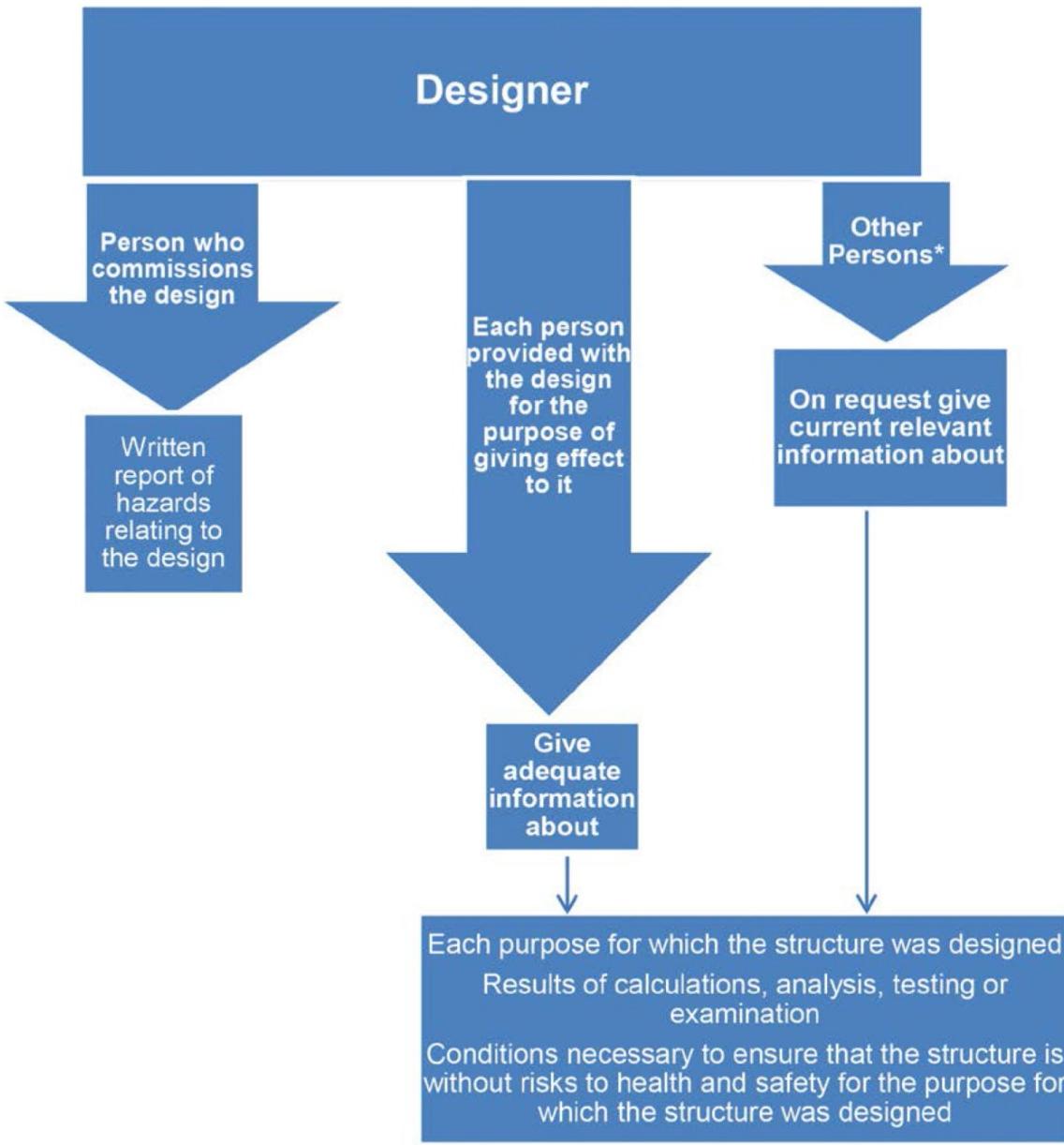 Figure 1 — A designer's safety information flows to client → principal contractor → workers. Each link is a duty under WHS Act s.22 and Reg 295. Don't break the chain.
6. Site induction
General Construction Induction Card ("white card")
- Issued by a regulator after an RTO-accredited course.
- Every person undertaking construction work must hold one (managers, engineers, foremen, surveyors, labourers, tradespeople, visitors who do work).
- Valid; must be re-trained if the holder hasn't done construction work for 2 years.
- Worker keeps the card available for inspection.
- Inter-jurisdictional white cards are recognised unless suspended/cancelled.
Workplace-specific induction
Conducted by the PC (or their delegate). Covers:
- Site layout, hazards, underground services.
- Site rules, traffic management, no-go zones.
- Amenities, first-aid, emergency procedures.
- Supervision arrangements, access, security.
- The WHS Management Plan and the worker's right to inspect it.
Delivery: toolbox talks, pre-starts, on-the-job, online — whatever proves the worker understands it.
7. Construction-site amenities
Same standards as workplace_environment_and_facilities — toilets, hand-washing, drinking water, eating, change rooms, showers (if hazardous work). Mobile/portable facilities OK; must be regularly serviced. Multi-storey: at least one toilet per 3 floors with in-building access.
8. Hazardous chemicals, asbestos, services
Hazardous chemicals on site
- Identified, registered, labelled.
- SDS available for each.
- Stored secure, marked, separate from non-hazmat.
- See §06 managing_risks_of_hazardous_chemicals (Phase 4).
Asbestos pre-check
- For renovation / demolition of any structure pre-Dec 2003: assume present until proven otherwise.
- Designer's safety report should flag known ACM.
- SWMS mandatory before any disturbance.
- See §07 manage_and_control_asbestos.
Underground essential services (Reg 304)
- Before excavation: obtain current location, depth, type via Dial Before You Dig or site records.
- Provide info to all excavating PCBUs (foundations, plumbing, electrical, landscape).
- Verify they understand it.
- Keep records until excavation complete (2+ yrs if notifiable incident).
Energised electrical / pressurised services
- Drilling near hidden wiring; near overhead/underground power; near pressurised gas/chemical/fuel/refrigerant — HRCW, SWMS required.
9. Records to keep
| Record | Retention |
|---|---|
| WHS Management Plan (all versions) | Project complete + 2 yrs if incident |
| SWMS (all versions) | HRCW complete + 2 yrs if incident |
| Hazardous chemicals register & SDS | While chemicals on site |
| Underground services info | Until excavation complete; 2+ yrs if incident |
| White card / induction evidence | For inspection by regulator |
| Toolbox / consultation records | Ongoing |
| Site-inspection checklists | Ongoing |
| Incident reports | 2+ yrs minimum |
10. Common pitfalls / quick wins
Do
- Verify white cards before mobilisation. Don't direct anyone to work without one.
- Prepare the WHS Management Plan before Day 1 — generic template tailored to site is fine.
- Collect SWMS at contract stage, not after mobilisation.
- Stop work the moment a SWMS is breached. Don't resume until the SWMS is fixed.
- Walk the site regularly — paperwork without observation is theatre.
- Document consultation: topics, attendees, decisions, dates.
- Dial Before You Dig before any excavation; pass results to the digging crew.
Don't
- Assume a generic white card = task competency. It covers general hazards, not your site's.
- Skip site signage. Missing PC sign = breach on day one.
- Try to contract your duty away. You can sub-contract the work; you can't sub-contract the duty.
- Leave excavations unsecured after hours. PC and sub both retain duty.
- Revise SWMS in isolation — consult workers and reissue the new version.
11. Cross-references
- See also: safe_design_of_structures, demolition_work, excavation_work, falls_in_housing_construction
- Generic falls: managing_risk_of_falls
- Foundations: risk_management_process, whs_consultation_cooperation_coordination
- Glossary (PCBU, SWMS, HRCW, white card, principal contractor): glossary_and_key_concepts
Source: construction_work.md (Safe Work Australia, model Code of Practice, CC-BY-NC 4.0). Edition: May 2018. Last verified against SWA: 2026-04-27.